
Innova 5610: Reading TPMS codes
The Innova 5610 can read Tire Pressure Monitoring System (TPMS) codes on most 96 and newer vehicles. TPMS trouble codes are usually stored in the Body Control Module (BCM) or a dedicated TPMS module, rather than the ABS module. However, the specific Diagnostic Trouble Codes (DTCs) themselves are almost always "C" (Chassis) or "B" (Body) codes.
- Body Control Module (BCM) or Dedicated TPMS Module. On most modern vehicles with Direct TPMS (physical pressure sensors inside each tire), the receiver antenna wires directly into the BCM or a standalone Tire Pressure Monitor module. Scanning the Body or TPMS module with the Innova 5610 is where you will find these faults.
-
ABS Module. On vehicles equipped with Indirect TPMS (common on many Honda, Volkswagen, Audi, and Mazda models), there are no pressure sensors inside the wheels. Instead, the system uses the ABS wheel speed sensors to calculate tire rotation differences. On these vehicles, tire pressure warnings or calibration faults are often stored inside the ABS / Brake Control Module.
By Code Prefix (What the Code Looks Like) - Chassis Codes (
Cxxxx). Even when stored inside the Body Control Module, most manufacturers classify tire and wheel sensor faults under the Chassis category (e.g.,C1210orC2045for sensor signal/battery faults). - Body Codes (
Bxxxx). Some automakers (such as Ford and Honda/Acura) use Body codes (e.g.,B124D) for TPMS sensor communication and receiver issues. - Network Codes (
Uxxxx). If the TPMS module or BCM loses communication with the instrument cluster or gateway, it will set aU-code.
Step 1 - Press the System Status button
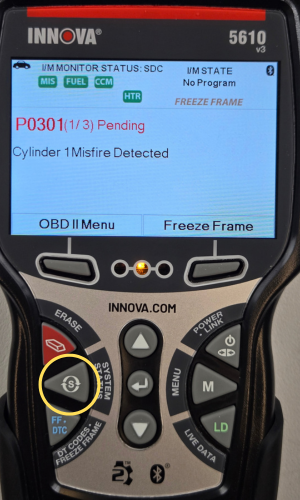
- Press the System Status button.
Step 2 - Scroll down to TPMS
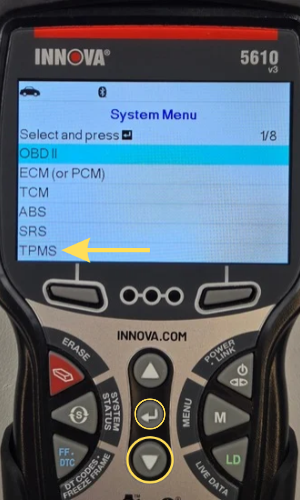
- Scroll through the options by pressing the DOWN ▼ button & select TPMS, then press ENTER ↵.
Step 3 - View TPMS code(s) in dedicated TPMS module
|
|
|

- TPMS trouble codes are usually stored in the Body Control Module (BCM) or a dedicated TPMS module.
- In the example above, the 5610 is connected to a 2015 Chevy Equinox which has a dedicated TPMS module.
- TPMS Codes(s) will display if stored in the TPMS Module.
- Press the UP ▲ and DOWN ▼ buttons to navigate through the code descriptions
- Press the Diagnostic Menu button to return to the Diagnostic Menu.
|
|
|


- In this example, the 5610 is reading TPMS codes from a 2020 Ford F150.
- TPMS codes are stored in the BCM on this vehicle.
- A One moment please... message will display as the 5610 loads the stored TPMS codes.
NOTE: Ford generally does not use a standalone, dedicated TPMS control module on most models. Instead, TPMS logic is integrated into larger modules like the Body Control Module (BCM) or Smart Junction Box (SJB), with a separate RF receiver / Radio Transceiver Module (RTM) picking up the wheel sensor signals
Step 4 - Select Read DTCs
|
|
|


- Select Read DTCs, then press ENTER ↵.
- Select Continuous Memory DTCs, then press ENTER ↵.
- Press the Back button to return to the previous screen.
Note: If TPMS functionality is not supported, an advisory message will show.
Step 5 - Scroll through your TPMS codes
|
|
|


- Press the UP ▲ and DOWN ▼ buttons to scroll through the TPMS codes.
- You may refer to Display Functions for a description of each display element.
- When the last retrieved DTC has been displayed press the DOWN ▼ button again to return to the first code.
- If the definition for the currently displayed code is not available, an advisory message will show.
- In the case of codes with long definitions, a small arrow will show in the upper/lower right-hand corner of the screen to indicate the presence of additional information.
- If no codes are present, the message No TPMS DTCs are presently stored in the vehicle’s computer will show.
- To exit the TPMS code screen, press the Diagnostics Menu button.
Note: You may also press the DTC/FF button to scroll through your codes one at a time.